Louis Leakey
At Fort Ternan (east of Lake Victoria) in 1962, Leakey's team discovered the remains of Kenyapithecus, another link between apes and early man that lived about 14 million years ago. Leakey's discoveries formed the basis for the most important subsequent research into the earliest origins of human life.
› biography › Louis-Leakey
Where is man originated in East Africa?
H. sapiens most likely developed in the Horn of Africa between 300,000 and 200,000 years ago. The "recent African origin" model proposes that all modern non-African populations are substantially descended from populations of H. sapiens that left Africa after that time.
Who found bones in East Africa?
Lucy & the Leakeys. Until the 1950s, European scientists believed that Homo sapiens evolved in Europe, or possibly in Asia, about 60,000 years ago. Since then, excavation of fossil bones in East Africa, pioneered by Mary and Louis Leakey, has revealed that Homo sapiens may have emerged in Africa much earlier.
Who discovered the skull of early man?
There is a piece of Africa where mankind first emerged in the world – the Olduvai Gorge known as the 'Cradle of Mankind'. It was in this area that Louis Leakey discovered the skull of theNutcracker Man, which dates back to over 1.7 million years old.
What was found at the Olduvai Gorge?
Olduvai Gorge is a site in Tanzania that holds the earliest evidence of the existence of human ancestors. Paleoanthropologists have found hundreds of fossilized bones and stone tools in the area dating back millions of years, leading them to conclude that humans evolved in Africa.
Archaeologists Have Discovered The Oldest Human Fossil Ever Found Outside Africa
Who discovered the oldest skull of early man in East Africa?
Reconstructed replica of “Nutcracker Man,” a 1.75-million-year-old Paranthropus boisei skull found in 1959 by archaeologist Mary Leakey at Olduvai Gorge, Tanzania. The skull was originally classified as Zinjanthropus boisei by Louis Leakey.
Which fossil discovery was found in Olduvai Gorge in East Africa?
The jaw belongs to the original, or type, specimen of Homo habilis, or "Handy Man," so-called by its discoverers Louis and Mary Leakey in 1964 because it was found in Olduvai Gorge in Tanzania in sediments that also contained the oldest stone tools known at the time.
Where was the first skull found?
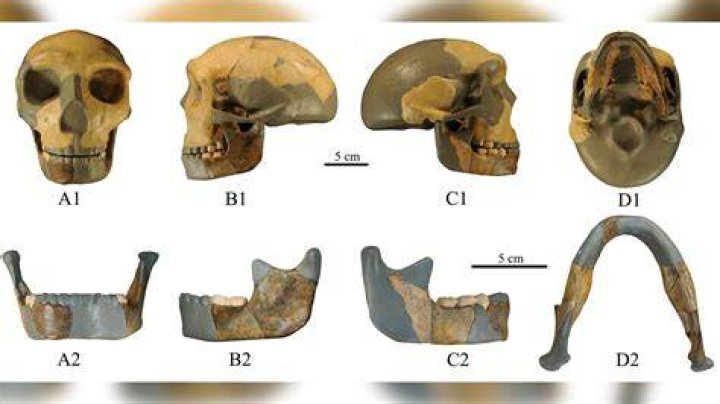
A 32,000-year-old skull discovered in central China is oldest known human fossil found in Henan province.
Where was the first human skull discovered?
One fossil, a skull found near the Omo River in southern Ethiopia, does have all the hallmarks of anatomically modern humans; among other traits, Omo I has a chin and a tall cranium. The skull was buried (probably not on purpose) in a layer of sediment that was later covered by ash from at least one volcanic eruption.
Where is the skull found?
skull, skeletal framework of the head of vertebrates, composed of bones or cartilage, which form a unit that protects the brain and some sense organs. The upper jaw, but not the lower, is part of the skull.
Where were the first human remains found in Africa?
On November 24, 1974, fossils of one of the oldest known human ancestors, an Australopithecus afarensis specimen nicknamed “Lucy,” were discovered in Hadar, Ethiopia.
Where were the oldest human remains discovered in Africa?
Some of the oldest human remains ever unearthed are the Omo One bones found in Ethiopia. For decades, their precise age has been debated, but a new study argues they're around 233,000 years old.
What is the earliest human remains found?
The oldest known evidence for anatomically modern humans (as of 2017) are fossils found at Jebel Irhoud, Morocco, dated about 360,000 years old. Anatomically modern human remains of eight individuals dated 300,000 years old, making them the oldest known remains categorized as "modern" (as of 2018).
What color was the first human?
Color and cancer
These early humans probably had pale skin, much like humans' closest living relative, the chimpanzee, which is white under its fur. Around 1.2 million to 1.8 million years ago, early Homo sapiens evolved dark skin.
Is Kenya the cradle of mankind?
Kenya's human fossil record dates back to the last 6 million years, making Kenya undisputedly the oldest record holder and truly the Cradle of Mankind. There is ample accommodation at this facility; The Koobi Fora Campsite, provided by the National Museums of Kenya.
Who is the first person in Africa?
The First Humans
One of the earliest known humans is Homo habilis, or “handy man,” who lived about 2.4 million to 1.4 million years ago in Eastern and Southern Africa.
Who discovered the first humanoid skull in Africa?
Lucy was discovered in 1974 in Africa, at Hadar, a site in the Awash Valley of the Afar Triangle in Ethiopia, by paleoanthropologist Donald Johanson of the Cleveland Museum of Natural History. Catalog no. The Lucy specimen is an early australopithecine and is dated to about 3.2 million years ago.
Where was the oldest human fossil found Ethiopia?
Earlier fossil discoveries
Until now, the oldest fossil skeleton of a human ancestor was the 3.2-million-year-old partial skeleton of Lucy, discovered in the Afar depression of Ethiopia, near Hadar, in 1974 and named Au. afarensis.
What name was given to the oldest skull of early man?
afarensis is probably the partial skeleton known as Lucy, which was for a long time viewed as the oldest known human ancestor.
What was found in South Africa?
Scientists have announced the discovery of a new human ancestor in South Africa. The fossils, found in a cave 30 meters underground, contain a mixture of human and ape-like traits and paint a picture of a transitional hominin between apes and humans. The bones were discovered within a cave system called Rising Star.
Where was the skull found in after Blenheim?
Ans. Kaspar's grandson Peterkin had found a smooth, round object while playing. He was playing beside the rivulet where he found this object, which was actually the skull of a soldier who died during the Battle of Blenheim.
Who was the earliest known ancestor of man?
Ardipithicines. Ardipithecus is the earliest known genus of the human lineage and the likely ancestor of Australopithecus, a group closely related to and often considered ancestral to modern human beings. Ardipithecus lived between 5.8 million and 4.4 million years ago.
In which region is Olduvai Gorge found?
Olduvai Gorge is a 50-km-long (30-mile), 90-meter-deep (295-foot) ravine located in the eastern Serengeti Plains of northern Tanzania, within the Ngorongoro Conservation Area.
What skull did Richard Leakey find?
Paleoanthropologist Richard Leakey holds the skull of the hominid Australopithecus robustus, which he found in August 1969 at East Turkana, Kenya. The skull was dated at around 1.6 million years old.